IT Outsourcing vs Staff Augmentation: Key Differences Explained
September 9, 2026 2026-09-09 3:05IT Outsourcing vs Staff Augmentation: Key Differences Explained
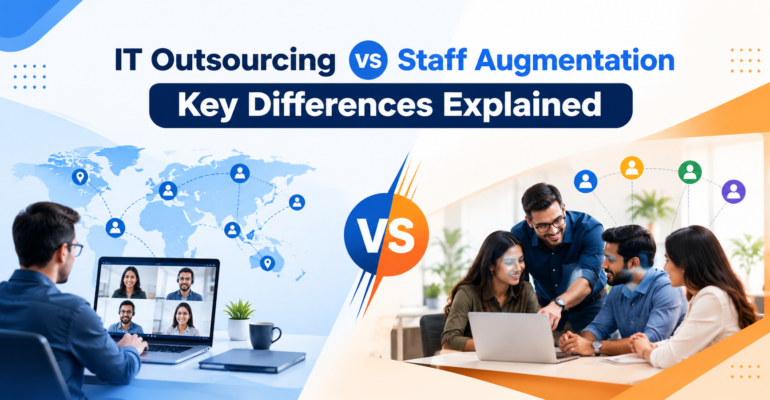

Every growing technology team eventually reaches the same wall. Internal capacity runs out, timelines are fixed, and hiring full time engineers takes longer than the project can wait. At that point, most companies land on the same two options, IT Outsourcing and Staff Augmentation. Both bring in external technical talent, and on the surface they can look almost identical in a sales pitch. In practice, they operate on completely different principles, and choosing the wrong one is one of the more expensive technical decisions a business can make.
This article gives a clear, technical breakdown of IT Outsourcing vs Staff Augmentation, including how each model actually works day to day, where the cost differences really come from, who owns intellectual property and compliance risk under each model, and a practical framework for deciding which one fits your project. At Ashu Dividend, we work with businesses making exactly this decision, so this breakdown reflects what we see play out in real engagements, not just theory.
What Is IT Staff Augmentation?
Staff augmentation means adding external engineers directly into your existing internal team. These professionals attend your standups, follow your existing workflows, use your existing tools, and report to your internal managers. You retain full control over priorities, architecture decisions, and daily direction. The augmented staff supply the skills and additional capacity, while your team supplies the leadership and structure around the work.
This model works well when your internal team already has strong technical leadership and simply needs more hands to execute against an existing roadmap.
What Is IT Outsourcing?
IT Outsourcing works differently. Instead of adding individuals into your team, you hand over an entire project or function to an external provider, who manages their own team, their own process, and their own delivery timeline. You define the outcome you need. The vendor decides how to get there. This is why partnering with a dedicated IT Outsourcing Company often comes with fixed deliverables and a defined scope, rather than day to day involvement from your side.
This model works well for clearly scoped, non core projects where your internal team does not have the bandwidth or need to manage engineers directly.
IT Outsourcing vs Staff Augmentation Side by Side
| Factor | Staff Augmentation | IT Outsourcing |
| Who directs daily work | Your internal team | The outsourcing provider |
| Best suited for | Ongoing product work with evolving scope | Well defined, self contained projects |
| Cost structure | Lower hourly rate, no management markup | Higher rate that includes management overhead |
| Management effort required from you | High, since you lead the engineers | Low, since the vendor manages delivery |
| Speed to change scope | Fast, since it is a direct conversation | Slower, often requires a formal change order |
| Ideal contract length | Flexible, can be short or long term | Typically project based or fixed term |
| Risk if the relationship ends | Lower, since work stays inside your systems | Higher, since knowledge may sit with the vendor |
Where the Real Cost Differences Come From?
Neither model is inherently cheaper, and treating this as a simple rate comparison usually leads to the wrong decision. Staff augmentation typically has a lower hourly rate because there is no project management layer built into the price, but it requires real time investment from your internal leadership to direct the work. IT Outsourcing usually carries a higher blended rate because project management, quality assurance, and delivery coordination are already included, which removes that burden from your team but reduces your day to day visibility into how the work gets done.
The more accurate way to compare cost is to account for total cost, not just the rate. This includes your internal management time, the cost of handling scope changes under each model, and the cost of knowledge transfer if the engagement ends. A low quoted rate from an outsourcing provider with poor change control can end up costing more in rework than a slightly higher rate from a well managed IT Outsourcing Services provider with clear processes in place.
Intellectual Property, Data Access, and Compliance Ownership
This is one of the most overlooked differences between the two models, and it deserves direct attention.
Under staff augmentation, augmented engineers typically work inside your existing systems, using your access controls, your repositories, and your security policies. This generally keeps intellectual property and data access under your direct governance, which matters significantly for companies in regulated industries or those protecting proprietary technology.
Under IT Outsourcing, the vendor often works within their own environment and their own tooling, at least for part of the engagement. This makes clear contractual terms around intellectual property ownership, data handling, and compliance responsibility essential before work begins. A reputable IT Outsourcing Company will have established data handling and compliance practices, but it remains the client’s responsibility to verify these terms rather than assume them
Hybrid IT Outsourcing and Staff Augmentation Model
Most companies that scale successfully do not choose one model exclusively. They combine both, matching each model to the type of work it suits best.
A common structure looks like this. Core product development, especially work tied to your architecture and long term roadmap, stays with an internally directed staff augmentation team. Clearly scoped, self contained work, such as a platform migration, a specific integration build, or ongoing infrastructure monitoring, gets handed to an outsourcing partner with defined deliverables.
This hybrid approach keeps strategic, evolving work under your direct control while removing well defined, lower priority work from your internal team’s plate. The key to making it work is drawing a clear boundary upfront between what stays managed internally and what gets delegated, since blurred boundaries are where most hybrid engagements run into trouble.
How to Choose Between IT Outsourcing and Staff Augmentation?
Use the following questions to guide your decision. The more answers that point to the left column, the more staff augmentation fits your situation. The more that point to the right, the more a defined IT Outsourcing Services engagement fits.
- Do you have strong internal technical leadership available to direct the work, or do you need someone else to own delivery entirely.
- Is the scope likely to change frequently as you learn more, or is it well defined and unlikely to shift.
- Is this core product work tied to your long term architecture, or is it a self contained, non core project.
- Do you want ongoing flexibility to redirect engineers quickly, or are you comfortable with a fixed scope and formal change process.
- Is keeping intellectual property and data fully inside your own systems a priority, or is that manageable through contractual terms with a vendor.
If most of your answers point toward needing control, ongoing flexibility, and internal leadership involvement, staff augmentation is likely the better fit. If most point toward a clearly scoped outcome with minimal internal management required, working with an established IT Outsourcing Company is likely the stronger choice.
Common Mistakes When Deciding Between IT Outsourcing and Staff Augmentation
- Choosing a model based on price alone, without accounting for the management effort or change control it requires.
- Using staff augmentation for a project with no internal technical leadership available to direct the engineers.
- Using outsourcing for evolving, undefined work that requires frequent redirection, which leads to constant change orders and delays.
- Assuming intellectual property and compliance terms are handled automatically, rather than confirming them explicitly in the contract.
- Treating the two models as mutually exclusive instead of exploring a hybrid structure that fits different parts of the work.
Final Thoughts
IT Outsourcing vs Staff Augmentation is not a question with one universal answer. The right choice depends on how much control you need over daily execution, how well defined your scope is, and how much internal management capacity you actually have available. Many businesses that scale well end up using both models at different stages, applying staff augmentation to core, evolving work and turning to a trusted IT Outsourcing Company for clearly scoped projects that do not need day to day oversight.
Understanding these differences upfront, rather than after a project has already gone sideways, is what separates a smooth external engagement from one that costs far more than it saves.
If you are weighing IT Outsourcing vs Staff Augmentation for an upcoming project, Ashu Dividend can help you assess your specific situation and structure the right engagement, whether that means a defined IT Outsourcing Services partnership, an augmented team working inside your own systems, or a hybrid of both.
FAQs
1. What is the difference between IT outsourcing and staff augmentation?
The core difference is control. In staff augmentation, your internal team directs the daily work of the external engineers. In IT outsourcing, the provider manages their own team and delivers a defined outcome.
2. Which model is cheaper, staff augmentation or outsourcing?
Neither is inherently cheaper. Staff augmentation has a lower hourly rate but requires more internal management time. Outsourcing has a higher blended rate that already includes management and delivery coordination.
3. What are the benefits of IT outsourcing?
IT outsourcing gives businesses access to specialized expertise without hiring full time staff, transfers project management and delivery responsibility to the vendor, provides more predictable fixed costs for defined scopes, and frees up internal teams to focus on core priorities instead of managing external engineers day to day.
4. What are the benefits of staff augmentation?
Staff augmentation gives businesses direct control over how the work gets done, allows fast scope changes without formal change orders, keeps intellectual property and data inside your own systems, and lets augmented engineers integrate closely with your existing team, processes, and long term product knowledge.
5. What are the different types of IT outsourcing?
The main types are project based outsourcing for a single defined deliverable, and managed services outsourcing for ongoing functions like infrastructure or support. Outsourcing is also grouped by location as onshore, nearshore, or offshore, based on how much cost savings versus time zone overlap you need.